- Operating context
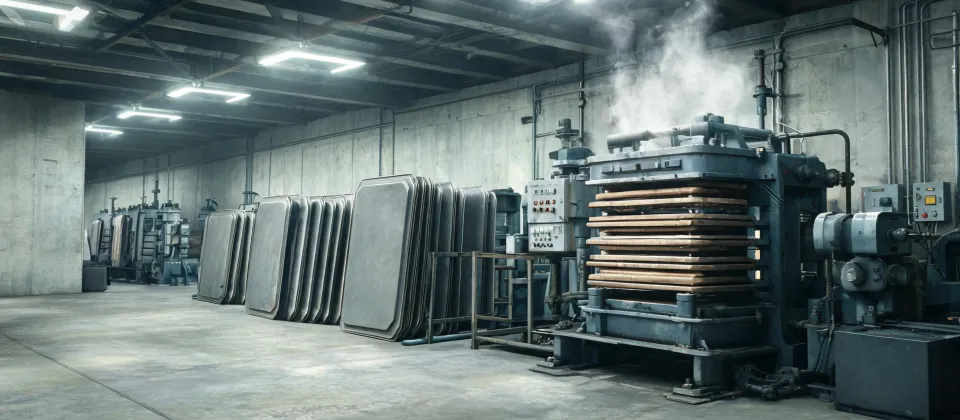
- A pads factory typically loads a large-plan mold, closes heated platens, vents or exhausts, holds dwell, then demolds. Upstream mix or mill output and downstream trim or punching must be named if they constrain press cycle time. Duty cycle is shifts and mold changes, not an unloaded ram speed.
Operating duty: Equipment scope
Ask how the proposed application affects rubber vulcanizing press for pads factory selection: platen size must cover the pad mold plan; daylight must clear mold plus loading method; heaters must hold the cure temperature across the thin but wide tool. Column versus frame access changes how operators place the pad mold. Do not treat a laboratory coupon press as a pad-production frame.
Price exclusions
Pad-specific molds, insert loading fixtures, vacuum, cooling, punching downstream of the press, installation and SAT travel are often extra. Machine price is not installed project cost. Shipping to the stated US destination, duties and training sit on separate lines unless the factory writes them together.
Response basis
Require temperature, dwell and venting steps from the rubber cure schedule, plus how platen uniformity and pressure holding are verified with the actual pad mold. A setpoint on the controller is not that evidence. Representative samples should include the thickest pad section the plant actually ships.
Remaining inputs: upstream mill or mix delivery method, downstream trim, three-phase supply, cooling water, extraction if the compound fumes, footprint, optional budget and supplier preference. Preference is a buyer selection, not a verified factory rating.
Industry trade-offs that belong on this page: a single press cell is not an integrated mill-to-punch line unless interfaces, staffing and acceptance boundaries are named. Nominal heater temperature is not validated pad output; request test conditions on the buyer compound. Working pressure on the hydraulic circuit must be converted with ram area before anyone treats it as clamp force. Changeover between pad SKUs may require different molds, not only a different dwell. FAT and SAT remain contract items with the named supplier.
Upstream and downstream interfaces to confirm include how mixed compound arrives, whether inserts are loaded by hand, and which sample tests (hardness, thickness, bond) the buyer will use after demold. Public production notes that mention exhaust steps and pressure replenishment are useful questions to copy into the RFQ; they are not a promise that every pads factory quote includes those functions. Read matching the mold and cure schedule before locking a press layout.
Selection factors for a pads factory press (not a named competitor ranking)
| Factor |
What the buyer records |
What the factory restates |
Limitation |
| Platen coverage |
Pad mold plan in mm |
Platen size in mm |
Edge heaters may still lag the center on a wide thin mold |
| Daylight |
Mold height plus loading method |
Opening in mm |
Usable clearance is less than advertised daylight if bolsters remain |
| Cure schedule |
Temperature, dwell, venting |
Control of those steps |
A controller program is not a compound qualification |
| Force language |
Cavity load and projected area if known |
Force or pressure with units |
Conflicting total-pressure units are not compared until ram area is given |